

NEWS DETAIL

Why Are Polished Quartz Boats Used in PERC Solar Cell Diffusion?
2026-10-29
PERC (Passivated Emitter and Rear Cell) technology improves solar cell efficiency by adding a passivation layer and a dielectric rear reflector to the conventional cell structure. During manufacturing, thermal diffusion is an important step in forming the required semiconductor junction. This process takes place at elevated temperatures, placing specific demands on the materials and components used inside the diffusion furnace.
A Polished Quartz Boat is designed to carry silicon wafers into the furnace while maintaining a suitable support structure under high-temperature conditions. Its material properties, surface quality, and dimensional accuracy all contribute to its suitability for solar cell manufacturing.
Understanding these characteristics helps explain why quartz wafer carriers are widely used in demanding thermal processes.
The Role of a Quartz Boat in PERC Solar Cell Diffusion
During PERC solar cell production, diffusion introduces dopant atoms into silicon wafers to form a region with the required electrical properties. The exact process depends on the cell architecture and manufacturing method, but it commonly involves controlled temperatures and a carefully managed process atmosphere.
A Quartz Wafer Boat holds and separates silicon wafers as they enter the diffusion furnace. Its slots or supporting features help maintain wafer positioning throughout the thermal cycle.
Consistent positioning is important because wafers must remain properly supported during loading, heating, and cooling. The boat must also fit the furnace configuration and accommodate the specified wafer dimensions.
Although the quartz boat does not directly determine the electrical performance of a solar cell, its dimensional stability, cleanliness, and structural condition can influence process consistency. An unsuitable or contaminated carrier may introduce particles or unwanted impurities, creating additional risks for wafer processing.
Why Quartz Is Suitable for High-Temperature Diffusion
Thermal Stability Under Elevated Temperatures
Fused quartz has a very low coefficient of thermal expansion, typically around 0.5 × 10⁻⁶/K near room temperature. This property helps it undergo relatively small dimensional changes when the temperature varies.
In a diffusion furnace, the quartz boat must tolerate repeated heating and cooling without excessive deformation. Its thermal properties help maintain the intended wafer-support geometry throughout these cycles.
However, quartz is not immune to thermal damage. Rapid temperature changes can create thermal stress, while prolonged exposure to unsuitable conditions may contribute to devitrification or deformation. Appropriate heating and cooling procedures, component geometry, and operating temperatures therefore remain important.
Chemical Resistance in Process Environments
Quartz offers good chemical resistance in many semiconductor and solar cell processing environments. This makes it suitable for applications involving elevated temperatures and controlled process gases.
Nevertheless, compatibility depends on the specific chemicals, temperature, exposure time, and cleaning agents involved. Certain substances, including hydrofluoric acid and strong alkaline solutions, can attack silica.
Selecting a quartz boat therefore requires consideration of the actual process atmosphere and maintenance procedures rather than relying on general material properties alone.
How Material Purity Helps Control Contamination
Material purity is particularly important in solar cell manufacturing because unwanted contaminants can affect silicon processing and contribute to defects or reduced production consistency.
A high-purity quartz boat helps minimize the risk of introducing impurities from the wafer carrier itself. The required purity grade should be matched to the process specifications and the manufacturer's contamination-control requirements.
Purity alone, however, does not guarantee a clean processing environment. Surface residues, handling practices, cleaning methods, and particles generated through wear or damage can also contribute to contamination.
For this reason, quartz components should be manufactured, cleaned, inspected, and handled according to appropriate procedures. Maintaining a clean surface and identifying cracks, chips, or other damage are important parts of routine equipment maintenance.
Does Polishing Make a Difference to Quartz Boat Performance?
The surface condition of a quartz boat can influence how easily it can be cleaned and how well it meets specified surface-quality requirements.
A Polished Quartz Boat has undergone additional surface finishing intended to achieve the required smoothness and appearance. Depending on the manufacturing process and the areas being polished, this treatment may help reduce surface irregularities where residues or particles could otherwise accumulate.
Polishing should not, however, be treated as a guarantee of higher material purity, lower contamination, or longer service life. These outcomes depend on the original quartz quality, the finishing method, cleaning procedures, and operating conditions.
For diffusion applications, the relevant considerations include:
-
Surface finish: The finished surface should meet the agreed requirements for smoothness and cleanliness.
-
Structural integrity: Polishing and subsequent handling should not compromise the component's required dimensions or strength.
-
Process compatibility: The finished quartz boat must remain suitable for the intended temperature, atmosphere, and cleaning cycle.
The value of polishing is therefore best assessed against the actual technical requirements of the application.
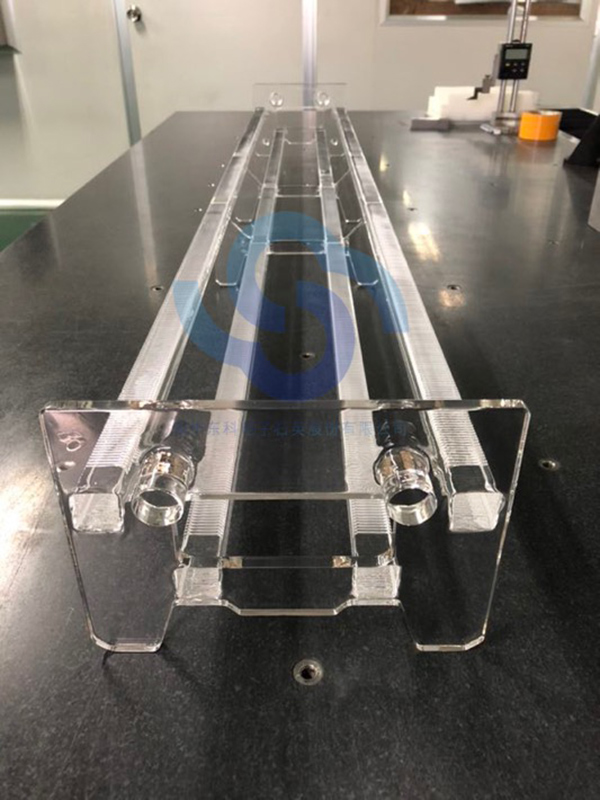
Design Considerations for a Quartz Wafer Boat
Material selection is only one part of producing a suitable quartz boat. Its dimensions and supporting structure must also correspond to the equipment and wafer specifications.
Wafer size, slot spacing, boat length, and furnace configuration can all affect the final design. If the slots are incorrectly dimensioned or the component does not fit the furnace properly, wafer loading and handling may become more difficult.
Custom manufacturing can address these requirements by using technical drawings, reference samples, or confirmed dimensional specifications. Before production, critical dimensions and surface requirements should be clarified to ensure that the finished component matches the intended application.
Inspection should then focus on the features that matter most to the design, including dimensional accuracy, surface condition, and visible defects. Where necessary, additional checks can be specified according to the customer's quality requirements.
A Custom Polished Quartz Boat for Solar Cell Diffusion
A custom-made polished quartz boat provides a practical example of how material properties and manufacturing details come together in a finished component.
For PERC solar cell diffusion, the quartz boat must provide reliable wafer support while tolerating the thermal conditions of the furnace. High-purity quartz, appropriate surface finishing, and accurate dimensions are therefore important considerations during manufacturing.
At DKEQ Electronic Quartz, customized quartz components can be developed according to specific drawings and application requirements. Dimensions, structural details, and surface specifications can be reviewed to determine whether a proposed design is suitable for the intended equipment and process.
Rather than relying on a standard configuration for every application, this approach allows the component to be evaluated against actual operating conditions. The final design should reflect the wafer specifications, furnace arrangement, and relevant material and cleanliness requirements.
Choosing a Quartz Boat for Consistent Diffusion Processing
A suitable quartz boat combines thermal stability, appropriate chemical resistance, controlled material purity, and a surface finish that meets the needs of the process.
For PERC Solar Cell Diffusion, these properties help establish the conditions required for reliable wafer handling inside a high-temperature furnace. A well-designed Quartz Wafer Boat must also maintain dimensional compatibility with the equipment and support the wafers throughout repeated thermal cycles.
A Polished Quartz Boat is therefore more than a wafer carrier with a smooth appearance. Its suitability depends on the relationship between material quality, surface condition, structural design, and the demands of the manufacturing process.