

NEWS DETAIL

How Are Custom Quartz Tubes Manufactured for Solar Cell Diffusion Equipment?
2026-11-16
Quartz tubes are essential components in solar cell diffusion equipment, where they provide controlled channels for process gases under high-temperature operating conditions. During PERC (Passivated Emitter and Rear Cell) solar cell manufacturing, the diffusion process requires stable thermal environments and carefully managed gas delivery. The quartz tube must therefore meet specific requirements for material purity, temperature resistance, chemical compatibility, and dimensional accuracy.
Unlike standard industrial tubing, a custom quartz tube is manufactured according to the equipment configuration and processing conditions in which it will be used. Dimensions, wall thickness, length, and material specifications all influence the suitability of the finished component. Understanding these manufacturing considerations helps explain how customized quartz tubes are developed for demanding solar cell production environments.
1. Selecting High-Purity Quartz Materials
Material selection is the starting point of quartz tube manufacturing. In solar cell diffusion applications, the tube is exposed to elevated temperatures and process gases, making material purity an important consideration.
A High Purity Quartz Tube is preferred for applications where contamination control is essential. Low impurity content helps minimize the potential introduction of unwanted metallic elements into the processing environment. This is particularly important in solar cell manufacturing, where material contamination may affect wafer quality and subsequent electrical performance.
Quartz also offers good chemical resistance under many commonly used diffusion conditions. However, its compatibility depends on the specific process atmosphere and cleaning chemicals. Material selection should therefore consider the actual gases, operating temperatures, and maintenance procedures involved.
The quality of the raw quartz material provides the foundation for the finished tube. Appropriate material specifications help ensure that the product meets the requirements of its intended application rather than relying on general material properties alone.
2. Determining Tube Diameter and Overall Length
The dimensions of a quartz tube must correspond to the design of the diffusion equipment. Internal diameter, external diameter, and overall length are among the primary specifications that need to be confirmed before manufacturing begins.
Tube diameter determines how the component fits into the furnace assembly and influences the available internal space for gas movement. If the diameter does not match the equipment requirements, installation may become difficult or the intended operating configuration may not be achieved.
Length is equally important. A quartz tube must accommodate the working area of the diffusion furnace while matching its supporting and connection arrangements. Different equipment configurations may require different lengths, even when the tubes serve similar functions.
For customized production, technical drawings or reference samples can help establish these dimensions. Confirming the measurement requirements at the beginning also reduces the possibility of dimensional discrepancies during subsequent manufacturing and assembly.
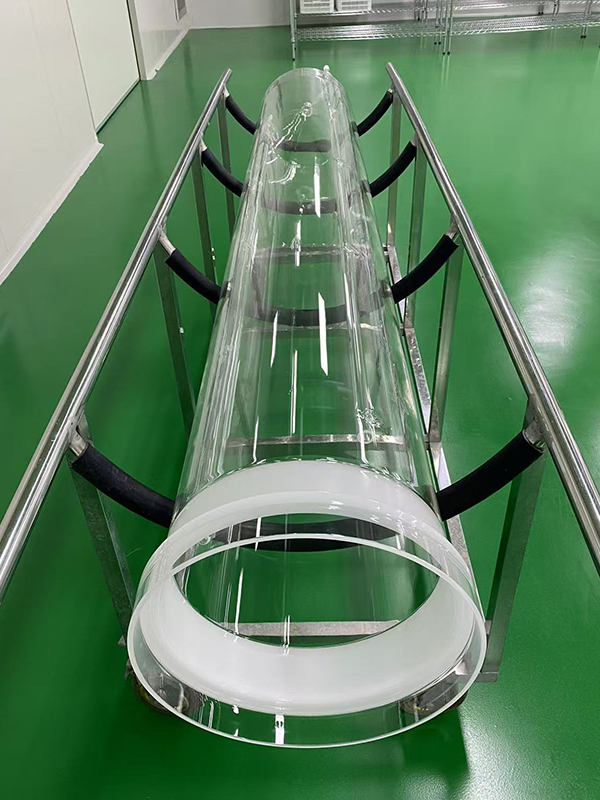
3. Controlling Wall Thickness for High-Temperature Applications
Wall thickness is another important factor in custom quartz tube design. It affects the tube's mechanical strength, thermal response, and suitability for its operating environment.
A tube with insufficient wall thickness may be more vulnerable to mechanical damage during handling or installation. Conversely, excessive thickness may increase material consumption and influence heating and cooling behavior.
For a High Temperature Quartz Tube, wall thickness should be determined according to operating temperature, tube diameter, mechanical support, and expected thermal cycling. Quartz has a relatively low coefficient of thermal expansion, which helps reduce dimensional changes during temperature fluctuations. Nevertheless, rapid heating or cooling can still generate thermal stress and potentially cause cracking.
Manufacturing specifications should therefore balance structural requirements with the thermal conditions of the diffusion process. There is no single wall thickness suitable for every application, so equipment specifications and actual operating conditions should guide the final design.
4. Shaping, Finishing, and Dimensional Inspection
Once the material and primary dimensions have been confirmed, the quartz tube can be processed according to the required configuration.
Depending on the product design, manufacturing may involve cutting, shaping, end finishing, and other specialized processing operations. Each step needs to maintain the specified geometry while minimizing surface defects.
Surface condition is particularly relevant for components used in controlled processing environments. Scratches, chips, cracks, and machining residues may affect handling safety, cleanliness, or structural reliability. Proper finishing and cleaning help prepare the tube for its intended application.
Dimensional inspection is another essential part of manufacturing. Key measurements may include:
-
▶ Internal and external diameters.
-
▶ Overall tube length.
-
▶ Wall thickness and thickness consistency.
-
▶ End geometry and other specified features.
Inspection requirements should be established according to the technical drawing and the customer's application. Checking these characteristics helps verify that the finished quartz tube corresponds to the agreed specifications.
5. Meeting Performance Requirements in Solar Cell Diffusion
A custom quartz tube must do more than fit the equipment. Its material and manufacturing characteristics also need to support the operating environment.
In PERC solar cell diffusion, the tube serves as a channel for process gases inside a high-temperature system. Its chemical compatibility and thermal stability are therefore important for maintaining the required processing conditions.
Light transmittance is another characteristic of quartz materials. High optical transparency may be relevant in equipment configurations involving radiant heating or optical access, although its practical importance depends on the furnace design.
For this reason, product specifications should be evaluated as a complete set. High purity, corrosion resistance, thermal performance, dimensional accuracy, and optical properties all contribute to determining whether a particular quartz tube is appropriate for its intended use.
6. Custom Quartz Tubes for Different Equipment Requirements
Solar cell diffusion equipment does not always use identical quartz tube configurations. Differences in furnace dimensions, installation structures, process conditions, and production requirements can create the need for customized components.
At DKEQ Electronic Quartz, custom quartz products can be evaluated according to customer drawings, dimensions, material requirements, and intended applications. This allows important specifications, such as tube diameter, length, wall thickness, and finishing details, to be considered before manufacturing.
For projects involving non-standard configurations, providing a technical drawing or reference sample helps clarify the required structure. Information about operating temperatures, process gases, and equipment interfaces can further support material and design evaluation.
A well-manufactured custom quartz tube is the result of matching material selection with precise dimensional requirements and appropriate processing techniques. By controlling these factors, quartz components can be developed to meet the specific demands of solar cell diffusion equipment.