

NEWS DETAIL

What Makes Quartz Tubes Suitable for High-Temperature Diffusion Processes?
2026-11-11
High-temperature diffusion is an essential step in semiconductor and solar cell manufacturing. During this process, silicon wafers are exposed to controlled temperatures and specific gas atmospheres to introduce dopants and modify their electrical properties. The equipment used must maintain a stable processing environment while minimizing contamination and material degradation.
Among the components used in diffusion furnaces, quartz tubes play an important role. They provide the process chamber through which wafers and process gases are accommodated under elevated temperatures. Their suitability comes largely from the distinctive properties of quartz, including thermal stability, chemical resistance, low impurity content, and optical transparency.
Understanding these characteristics helps explain why a High Temperature Quartz Tube is widely used in demanding thermal processing applications.
1. Excellent Thermal Stability Under Elevated Temperatures
One of the most important advantages of quartz is its exceptionally low coefficient of thermal expansion. Fused quartz typically has a thermal expansion coefficient of approximately 0.5 × 10⁻⁶/K near room temperature, significantly lower than that of many conventional glass materials.
This property allows a quartz tube to undergo temperature changes with relatively little dimensional variation. In diffusion furnaces, where heating and cooling cycles occur repeatedly, maintaining dimensional stability is important for preserving the geometry of the process chamber.
Quartz also has a high softening temperature, making it suitable for many high-temperature applications. However, its actual operating limits depend on the quartz grade, tube dimensions, heating conditions, and exposure duration.
Thermal stability does not mean that quartz is immune to damage. Rapid temperature changes, uneven heating, and mechanical stress can still cause cracking. Therefore, appropriate heating and cooling procedures are important for extending the service life of a quartz tube.
2. Chemical Resistance in Diffusion Furnace Environments
Diffusion processes involve different gas atmospheres depending on the required treatment. For example, phosphorus diffusion commonly uses phosphorus-containing sources, while boron diffusion involves different chemical precursors. Oxygen and nitrogen may also be introduced as part of the process atmosphere.
A Quartz Tube for Diffusion Furnace must remain chemically stable under its intended operating conditions.
High-purity fused quartz offers good resistance to many commonly used process environments, helping maintain the integrity of the furnace tube during repeated thermal cycles.
Nevertheless, chemical compatibility should always be evaluated according to the actual process chemistry. Hydrofluoric acid, certain alkaline substances, and some aggressive chemical environments can attack silica-based materials.
Selecting the appropriate quartz material therefore requires consideration of both operating temperature and chemical exposure. This helps reduce the risk of surface degradation and unwanted contamination during production.
3. Low Impurity Content for Process Contamination Control
Material purity is another critical consideration in semiconductor and solar cell manufacturing.
Silicon wafers are sensitive to metallic contamination. Even small quantities of certain impurities may affect electrical characteristics, carrier lifetime, and overall device performance.
Since the quartz tube forms part of the processing environment, its material quality can influence contamination control. High-purity quartz helps reduce the potential introduction of unwanted metallic elements into the furnace atmosphere.
However, material purity alone does not guarantee a clean processing environment. Manufacturing residues, surface deposits, cleaning procedures, and handling practices must also be controlled.
For this reason, raw material selection and production cleanliness should be considered together when manufacturing quartz tubes for demanding industrial applications.
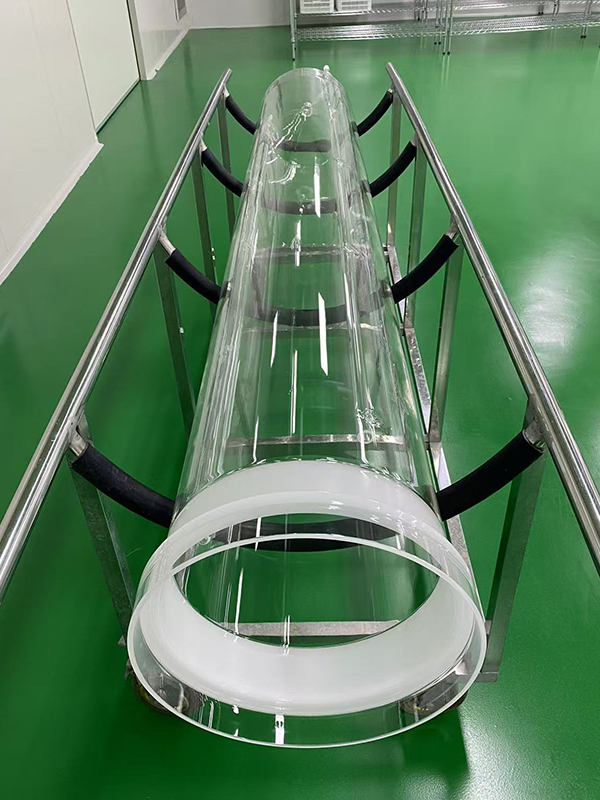
4. Optical Transparency and Its Practical Value
Quartz is also valued for its excellent optical transparency, particularly in the ultraviolet and visible wavelength ranges, depending on its grade and composition.
This characteristic can be useful in thermal processing equipment that incorporates optical temperature measurement, radiation-based heating, or other optical monitoring arrangements.
Compared with opaque materials, transparent quartz allows certain optical signals to pass through the tube wall, depending on wavelength and material specifications.
It is important to note that transparency is not the primary reason every diffusion furnace uses quartz tubes. Its practical value depends on the furnace configuration and heating technology. Nevertheless, it remains a useful material property when selecting quartz components for specialized thermal equipment.
5. Why Quartz Tube Dimensions and Manufacturing Quality Matter
Material performance is only one part of a suitable diffusion furnace tube. Its dimensions and manufacturing quality also influence equipment compatibility and operational reliability.
Several factors deserve attention:
-
Outer diameter and inner diameter: These dimensions must match the furnace design and provide the required internal processing space.
-
Wall thickness: Appropriate thickness helps balance structural strength, thermal response, and dimensional requirements.
-
Tube length: The overall length should correspond to the furnace chamber and installation configuration.
-
Surface quality: A clean, consistent internal surface helps reduce potential contamination sources and makes inspection easier.
Manufacturing accuracy is particularly important for custom quartz tubes. Dimensional deviations may create installation difficulties or affect the fit between the tube and associated furnace components.
For specialized applications, production requirements can be established through technical drawings, reference samples, and equipment specifications. This allows the tube geometry and material grade to be evaluated according to the intended operating environment.
6. Applications of High Temperature Quartz Tubes
High-temperature quartz tubes are used in various thermal processing applications, including semiconductor diffusion, oxidation, and solar cell manufacturing.
In PERC solar cell production, for example, the quartz tube serves as a process channel through which diffusion gases are introduced into the high-temperature furnace environment. Its thermal resistance and chemical stability help maintain the required processing conditions.
Different production systems may require different tube diameters, lengths, wall thicknesses, and material specifications. Custom configurations can therefore be developed to accommodate specific furnace structures and process requirements.
At DKEQ Electronic Quartz, customized quartz components are manufactured according to application requirements and technical specifications. By considering material properties alongside dimensional accuracy and manufacturing quality, quartz tubes can be tailored to the needs of different high-temperature processing systems.
Selecting Quartz Tubes for Reliable Thermal Processing
The suitability of quartz tubes for high-temperature diffusion processes comes from the combination of several material advantages. Low thermal expansion supports dimensional stability, chemical resistance helps withstand suitable process atmospheres, and high purity contributes to contamination control.
Optical transparency provides additional value in equipment where optical properties are relevant.
Ultimately, selecting a suitable High Temperature Quartz Tube requires more than considering its maximum temperature resistance. Material grade, chemical compatibility, tube dimensions, and manufacturing quality must all correspond to the actual processing environment. When these factors are properly evaluated, quartz tubes provide a reliable foundation for demanding diffusion furnace applications.